How to Conduct an Impact Assessment: A Step-by-Step Guide
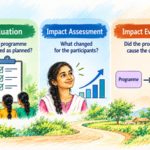
Completing a project is not the same as completing an impact assessment.
Let’s consider Project Unnati as an illustrative example. A not-for-profit organisation launched the programme to improve financial inclusion among adolescent girls in rural communities through digital financial literacy training.
After three years, the programme came to an end. The organisation prepared a completion report showing that 15 community hubs were established, 500 training sessions were conducted, and 1,000 girls completed the training programme.
On paper, the programme appeared successful. However, the completion report did not answer the questions that mattered most. The donor and the organisation’s board wanted to understand what lasting change the programme had created.
- Did the girls continue using digital banking services independently?
- Did their financial confidence improve?
- Did the programme create lasting financial inclusion?
Answering these questions requires a systematic impact assessment. The organisation now needs to plan and conduct an impact assessment to gather credible evidence about the changes associated with the programme and the factors that may have contributed to those changes.
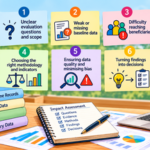
Conducting an impact assessment involves much more than collecting data at the end of a programme. It requires careful planning, selecting appropriate methods, collecting reliable evidence and interpreting the findings. In this guide, we’ll explain the impact assessment process through eight practical steps. The impact assessment framework below provides an overview of the process.

Step 1: Understand the Programme and Define the Scope
The first step in conducting an impact assessment is to clarify the purpose of the assessment and the key questions it needs to answer. This helps determine what the assessment should focus on and what evidence will be required.
The assessment team should then develop a thorough understanding of the programme by reviewing key documents such as the project proposal, Theory of Change, logframe, monitoring reports, baseline studies and completion reports. These documents help the team understand the programme’s objectives, target beneficiaries, activities, expected outcomes and available evidence.
Based on this understanding, the team can define the scope of the assessment, including the target beneficiaries, geographical coverage and assessment period.The team should also clarify how the findings will be used, such as informing programme redesign, scaling decisions, funding decisions or future programme planning.
Project Unnati In Practice
The starting questions are already clear:
- Did the girls continue using digital banking services?
- Did their financial confidence improve?
- Did the programme contribute to lasting financial inclusion?
These questions would guide the programme documents reviewed, beneficiaries included, geographical coverage and assessment period.
Step 2: Develop the Evaluation Framework
Once the programme and assessment scope are clearly defined, the next step is to develop the evaluation framework. An evaluation framework is simply a structured plan that outlines the evaluation questions, indicators and evidence needed to assess a programme’s impact. This helps determine what the assessment needs to measure and what evidence is required to answer the evaluation questions.
Building on the initial questions identified while defining the scope, refine them into clear evaluation questions that align with the programme objectives and Theory of Change. TThen identify the indicators that will be used to measure the intended outcomes and longer-term changes.
A well-designed evaluation framework ensures that the assessment remains focused and collects only the information needed to generate credible evidence.
Project Unnati In Practice
The evaluation could examine whether girls continued using digital banking services, whether their financial confidence improved and whether the programme contributed to greater financial inclusion. Indicators could include active use of bank accounts, frequency of digital transactions and confidence in using digital financial services.
Selecting appropriate impact assessment indicators helps translate evaluation questions into measurable evidence.

Step 3: Choose the Methodology
Once the evaluation questions and indicators have been defined, the next step is to choose the impact assessment methodology. Depending on the programme, evaluation questions and available resources, different impact assessment methods may be used, including quantitative, qualitative or mixed methods.
A mixed-method approach can provide a more comprehensive understanding of the changes associated with the programme by combining numerical evidence with beneficiaries’ experiences and perspectives.
The methodology should also define the sampling approach, data sources and methods that will be used to collect evidence.
Project Unnati In Practice
A mixed-method approach could combine beneficiary surveys with FGDs involving girls and their family members, and KIIs with trainers and community leaders. Given the programme size of 1,000 girls, the team could assess whether a census approach is feasible or whether an appropriate sample would provide sufficient evidence.
Step 4: Develop Data Collection Tools
Once the methodology has been finalised, the next step is to develop the data collection tools. These tools should be aligned with the evaluation questions and indicators to ensure that the required information is collected consistently.
Depending on the methodology, the assessment team may develop:
- Structured questionnaires for surveys
- Discussion guides for focus group discussions (FGDs)
- Interview guides for key informant interviews (KIIs)
- Observation checklists
- Document review templates
Before the actual data collection begins, it is good practice to pilot test the tools. This helps identify unclear questions, improve the flow of the questionnaire and ensure that the tools collect reliable and relevant information.
Step 5: Collect the Data
Once the data collection tools have been developed and pilot tested, the next step is to collect data from the selected respondents. This stage involves gathering information using the methods defined in the methodology, such as surveys, focus group discussions (FGDs), key informant interviews (KIIs) and document reviews. Data can be collected either digitally using mobile-based data collection platforms or manually using paper-based questionnaires, depending on the programme context and available resources.
To ensure data quality, the assessment team should train field investigators, obtain informed consent from participants, follow ethical practices and closely monitor the data collection process.
Organisations should also ensure that personal data is collected, stored and used in accordance with the Digital Personal Data Protection (DPDP) Act, 2023 and any applicable organisational data protection policies. Consistent implementation of these practices helps improve the accuracy, reliability and integrity of the findings.
Project Unnati In Practice
Since the girls were trained to use smartphones and digital applications, the assessment team could consider digital data collection where appropriate, depending on device access, connectivity and the assessment context. Participants should be informed about the purpose of the assessment and how their data will be used, with consent obtained in line with applicable data protection requirements.
Step 6: Analyse and Interpret the Findings
Once the data has been collected, the next step is to analyse and interpret the findings. Data analysis involves organising, cleaning and examining the data to identify patterns, trends and changes. Quantitative data is typically analysed using statistical techniques, while qualitative data is analysed by identifying common themes, experiences and insights.
The assessment team should also triangulate the findings by comparing information from different data sources and methods. This can help corroborate findings, identify inconsistencies, strengthen confidence in the evidence and provide a more comprehensive understanding of the changes associated with the programme.
The findings should then be interpreted in the context of the programme objectives, evaluation questions, Theory of Change and the defined scope of the assessment. This helps determine whether the programme achieved its intended outcomes, understand why certain results were achieved, identify lessons for future programme improvement and make evidence-based recommendations.
Project Unnati In Practice
Survey findings on financial knowledge, digital banking usage and financial decision-making could be triangulated with insights from FGDs and KIIs.This would help the team corroborate the findings and understand why certain outcomes were or were not achieved.
Step 7: Report the Findings and Recommendations
Once the findings have been analysed and interpreted, the next step is to prepare and present the impact assessment findings in a clear, concise and actionable manner. A well-structured report should present the assessment methodology, key findings, conclusions and recommendations supported by evidence. The report should also clearly state the limitations of the assessment so that readers understand the context in which the findings should be interpreted.
The findings should be shared with relevant stakeholders, including programme teams, management, funders and implementing partners. Presenting the findings in an accessible format, such as reports, presentations, dashboards or infographics, helps stakeholders understand the results and make informed decisions.
The recommendations should be practical, prioritised and directly linked to the evidence generated during the assessment. The ultimate purpose of an impact assessment is not only to measure impact but also to generate learning, improve programme design and strengthen future interventions.
Step 8: Use the Findings for Learning and Improvement
An impact assessment should not end with the submission of a report. The findings and recommendations should be used to strengthen future programmes, improve organisational strategies and support evidence-based decision-making. Lessons from the assessment can inform the design of new projects, refine organisational approaches and contribute to better programme outcomes.
Organisations should also share key learnings with programme teams, partners, funders and other stakeholders. Creating opportunities for reflection and learning helps build a culture of continuous improvement and ensures that evidence generated through the assessment is translated into action.
Project Unnati In Practice
Suppose the assessment found that girls had improved their financial knowledge but continued to face barriers due to limited family support. The organisation could use this evidence to include family engagement and post-programme support when designing future financial inclusion programmes.
Conclusion
Conducting an impact assessment is a systematic process that helps organisations understand whether their programmes have achieved the intended outcomes, what changes have occurred, and what factors may have contributed to those changes. By following a structured approach—from defining the scope and developing an evaluation framework to collecting data, analysing findings and applying the lessons learned—organisations can generate credible evidence to support better decision-making.
An impact assessment is more than an exercise in measuring results. It is an opportunity to understand what worked, what did not, what factors may have influenced the results, and how those insights can inform future programmes. When organisations embed impact assessment into their decision-making, they move beyond reporting activities to creating lasting social change.
Continue the Conversation
Every programme has its own context, challenges and aspirations. While the principles of impact assessment remain the same, the approach should always be tailored to the programme and the questions that matter most.
We hope this guide has provided a practical starting point for planning your own impact assessment. If you’d like to discuss your programme, exchange ideas or explore different approaches to measuring impact, we’d be happy to continue the conversation.
Meaningful impact assessment begins with asking the right questions—and the best answers often emerge through collaboration.
#ImpactAssessment #MonitoringAndEvaluation #SocialImpact #NGOs #CSR #MIRAImpact #MIRA