What is Impact Assessment
A practical guide for NGOs, CSR Foundations, and Development Organizations
Every development programme is designed to create change. It may aim to improve learning outcomes, strengthen livelihoods, or empower communities. Organisations invest significant time and resources to create meaningful change in the lives of their intended stakeholders.
To understand this better, consider an illustrative example called Project Unnati. In many rural communities, adolescent girls (aged 15–17) have limited access to financial services and often depend on family members for financial transactions. As digital payments become increasingly common, this lack of access can deepen existing inequalities.
To address this challenge, a not-for-profit organisation launched Project Unnati. The programme established community hubs and distributed tablets to help these girls:
- Use smartphones securely
- Open and operate bank accounts
- Protect themselves from digital fraud
The training sessions were conducted regularly over a three-year project period. At the end of the project, the team prepared a completion report and submitted it to the donor.
The report highlighted the following achievements:
- 15 community hubs established
- 500 training sessions conducted
- 1,000 girls graduated
On paper, the project appeared successful.
But do these numbers tell us whether the training helped these girls become financially inclusive?
Were they able to use banking services independently months after the training ended?
Did their financial confidence improve?
These are the questions that truly matter—and answering them usually requires looking beyond the immediate numbers to see the bigger picture. This is where impact assessment can be useful. It helps organisations move beyond reporting activities and outputs to understand the changes associated with their programmes and the factors that may have contributed to them.
In this article, we will explain what impact assessment is, why it matters, when it should be conducted, and how it helps NGOs, not-for-profits, and CSR foundations make better decisions.

Illustrative Example: Project Unnati is a fictional example used to explain the concepts discussed in this article.
What Is Impact Assessment?
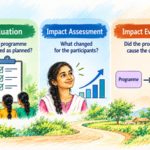
In simple terms, impact assessment seeks to understand the broader and higher-level changes associated with an intervention, including what changed, for whom, and to what extent. It also considers what factors may have contributed to those changes.
This is broadly consistent with the OECD-DAC definition of impact, which focuses on significant positive or negative, intended or unintended, higher-level effects.
An impact assessment also considers the extent to which the observed changes can reasonably be associated with the intervention, recognising that other factors may have contributed to the results.
Why is Impact Assessment important?
The core purpose of an impact assessment goes beyond reporting activities and outputs. Its primary objectives are to understand change, strengthen accountability, and generate learning that improves future programmes.
1. Strengthening Accountability
Development organisations are accountable to donors, governing boards, partners and the communities they serve. An impact assessment can provide evidence on the changes associated with an intervention and help organisations understand the extent to which the programme contributed to those changes. This evidence can strengthen accountability and support organisational learning and decision-making.
2. Improving Learning
Impact assessment is not only about proving success; it is equally about learning.
It helps organisations understand:
- What worked well?
- What did not work?
- Why were certain outcomes achieved?
- What can be improved in future programmes?
These insights help organisations make evidence-based decisions about whether to scale, redesign, replicate or discontinue a programme.
What does an Impact Assessment Measure?
To understand what an impact assessment measures, let’s revisit Project Unnati.

Stage | Project Unnati Example |
Activities | Established community hubs, distributed tablets and conducted 500 training sessions. |
Outputs | 1,000 adolescent girls completed the training programme. |
Outcomes | Girls learnt to use smartphones securely, opened and operated bank accounts, and started using digital payment services independently. |
Impact | Broader and longer-term changes such as improved financial inclusion, greater financial confidence, and reduced digital and financial exclusion among adolescent girls. |
This is a simplified results pathway. In practice, results can also be influenced by factors outside the programme.
The completion report captured the activities and outputs. However, it did not tell us whether the girls continued using digital financial services, became more financially confident, or experienced lasting financial inclusion. These are the kinds of changes that an impact assessment seeks to understand.
When Should an Organisation Conduct an Impact Assessment?
The timing of an impact assessment depends on the programme objectives, duration, type of intervention and the nature of the expected changes. An impact assessment may be conducted at different stages of a programme, depending on what the organisation wants to understand.

At the Beginning of the Programme
Impact should be considered from the beginning of a programme. This may involve developing the Theory of Change, defining indicators, identifying assumptions and risks, and collecting baseline data that can later support an assessment of change.
During the Programme
During implementation, monitoring and formative evaluation can help track emerging outcomes, identify implementation issues and understand factors influencing results. These findings can inform a later impact assessment.
At the End of the Programme
An impact assessment is often conducted at the end of a multi-year programme to understand what changes have occurred and whether the intended changes have been achieved.Ideally, it should be carried out after sufficient time has passed for meaningful changes to become evident. For example, Project Unnati could assess whether the girls continued using digital banking services independently after the training ended.
Before Scaling a Successful Programme
Before expanding a programme to new locations or populations, an impact assessment can help organisations understand the results of the programme and decide whether there is enough evidence to scale it. For example, before scaling Project Unnati to other districts, the organisation could assess what changed for the girls, what may have contributed to the change, and whether the changes were sustained.
Before Redesigning or Modifying a Programme
An impact assessment helps organisations understand what worked, what did not, and what can be improved before redesigning or modifying a programme.
When Required by Donors or Funding Agencies
Some donors and funding agencies require impact assessments to provide evidence of programme outcomes and longer-term effects. This can strengthen accountability and help inform future funding decisions.
The timing of an impact assessment should therefore depend on the questions the organisation needs to answer and when meaningful evidence is likely to become available.
How Is an Impact Assessment Conducted?
A typical impact assessment may involve the following steps, although the approach varies according to the programme, assessment questions, available evidence and intended use of the findings.
- Understand the programme by reviewing its objectives, Theory of Change and existing documentation.
- Develop the assessment methodology by defining assessment questions, selecting indicators and identifying the data required.
- Collect evidence through surveys, focus group discussions (FGDs), key informant interviews (KIIs) and secondary data review.
- Validate and verify the data to ensure its accuracy, completeness and reliability.
- Analyse the findings to understand the changes and outcomes, identify key insights and assess the factors influencing results.
- Present the findings and recommendations in a clear report to support evidence-based decision-making.
Each of these steps requires careful planning and appropriate methods. We’ll explore them in detail in our guide, How to Conduct an Impact Assessment: A Step-by-Step Guide.
Conclusion
The benefits of impact assessment extend beyond measuring results. It helps organisations understand the broader changes associated with their programmes, the factors that may have contributed to those changes, and what the findings mean for future decisions.
Let’s return to Project Unnati. While the completion report showed that 1,000 girls completed the training, it did not tell us whether they continued using digital banking services independently, became more financially confident, or remained protected from digital fraud. These are the kinds of changes that an impact assessment seeks to understand.
The evidence generated through impact assessments strengthens accountability, supports organisational learning, and enables better programme decisions. Whether you are designing a new programme, scaling a successful intervention or demonstrating results to donors, impact assessment provides evidence that can support better programme decisions.
Organisations that invest in understanding their impact are better positioned to improve programme quality, demonstrate accountability to donors, and make informed decisions about their programmes.
Frequently Asked Questions
1. Is impact assessment only for large organisations?
No. Organisations of all sizes can conduct impact assessments. The scope and methodology can be adapted based on the size of the programme, available resources and the purpose of the assessment.
2. How is impact assessment different from programme evaluation?
Programme evaluation assesses the overall performance of a programme, including its design, implementation and results. Impact assessment focuses on understanding the changes and effects associated with the programme, including what changed, for whom, how much, what may have contributed to the change, and what risks may affect the outcome.Learn more in our article Impact Assessment vs Evaluation: Understanding the Differences.
3. Can small NGOs conduct an impact assessment?
Yes. Small NGOs can conduct impact assessments using methods that match their resources and programme size. Even simple assessments can generate valuable insights for learning, accountability and programme improvement.
4. How often should an organisation conduct an impact assessment?
There is no fixed frequency. It depends on the programme objectives, duration and the time required for meaningful changes to become evident. Impact assessments are commonly conducted at the end of a programme, before scaling, or when required by donors.
5. What is the difference between outputs, outcomes and impact?
Outputs are the immediate results of programme activities, such as the number of people trained. Outcomes refer to the changes experienced by participants or communities following the programme. Impact refers to the broader and more significant changes and effects associated with the programme, including intended or unintended changes.
Ready to Measure Your Programme's Impact?
Measuring real change isn’t always easy, but you don’t have to figure it out alone. Every programme has a unique story, and an impact assessment helps you understand what changed and what may have contributed to those changes.
If you are looking to strengthen your evaluation framework or design your next impact assessment, MIRA Impact Consulting is here to help. Reach out to our team to chat about how we can support your mission—or explore our practical guides to keep building your evaluation toolkit.
#ImpactAssessment #MonitoringAndEvaluation #SocialImpact #NGOs #CSR #MIRAImpact #MIRA